
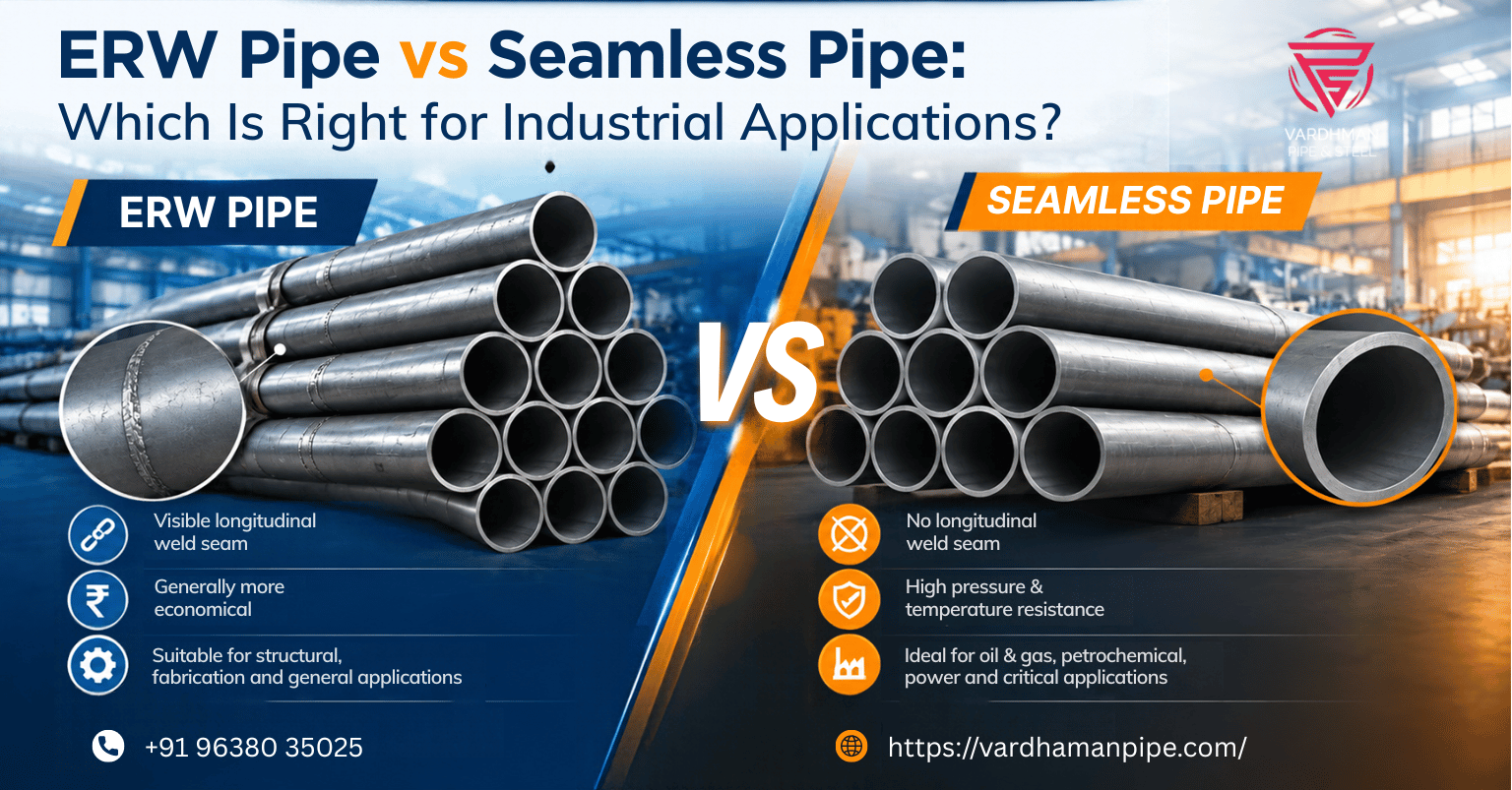
Choosing between ERW pipes and seamless pipes is an important decision for industrial buyers, engineers, contractors and procurement teams. The right choice depends on the application, operating pressure, temperature, material grade, wall thickness, applicable standards and overall project requirements.
Both ERW and seamless steel pipes are widely used in industrial and engineering applications, but they differ in their manufacturing processes, construction, availability and typical uses. Understanding the difference between ERW and seamless pipes can help buyers shortlist suitable products, evaluate specifications and avoid unnecessary costs.
In this guide, Vardhman Pipe & Steel explains how ERW pipes compare with seamless pipes, where each type may be suitable, and what to check before placing an industrial pipe order.
What Are ERW Pipes?
ERW stands for Electric Resistance Welded. ERW pipes are manufactured by forming flat steel strip or coil into a cylindrical shape and joining the edges using electric resistance welding. The resulting pipe has a longitudinal weld seam along its length.
ERW steel pipes are available in different sizes, wall thicknesses, materials and specifications. Their suitability depends on the manufacturing quality, applicable product standard and intended application.
Common applications include:
- Water distribution and general fluid conveyance, where the pipe specification is suitable
- Structural frameworks and fabrication
- Fencing, railings and support structures
- Selected industrial piping systems
- Engineering and manufacturing applications
When selecting ERW pipes, buyers should check the required dimensions, material grade, wall thickness, weld quality, testing requirements and applicable standard rather than relying on the pipe type alone.
What Are Seamless Pipes?
Seamless pipes are steel pipes manufactured without a longitudinal welded seam. A common manufacturing method involves heating a solid steel billet, piercing it to form a hollow section, and then processing it through rolling, sizing or other suitable operations to achieve the required dimensions.
MS seamless pipes are used in various industrial and engineering applications where the specified material and pipe dimensions meet the design requirements.
Common applications may include:
- Industrial machinery and engineering equipment
- Oil and gas installations, where the required specification is met
- Power generation and process industries
- Hydraulic and mechanical systems designed for the selected pipe
- Other applications requiring seamless pipe construction
Seamless pipes are often considered for demanding service conditions. However, the absence of a weld seam does not automatically make every seamless pipe stronger or suitable for every high-pressure application. Material grade, wall thickness, manufacturing quality, testing and compliance with the required standard remain essential.
ERW Pipe vs Seamless Pipe: Key Differences
The main difference between ERW pipes and seamless pipes is how they are manufactured. That difference affects the pipe’s construction, but it does not independently determine whether a pipe is suitable for a particular project.
| Comparison factor | ERW pipes | Seamless pipes |
|---|---|---|
| Manufacturing process | Steel strip or coil is formed and longitudinally welded | A solid billet is pierced and processed into a hollow pipe |
| Longitudinal weld seam | Present | Absent |
| Typical cost | Often economical, depending on size, grade and specification | Often higher, depending on size, grade and specification |
| Dimensional and quality requirements | Must meet the relevant product specification and quality controls | Must meet the relevant product specification and quality controls |
| Pressure suitability | Depends on material, dimensions, manufacturing quality, testing and applicable standard | Depends on material, dimensions, manufacturing quality, testing and applicable standard |
| Common applications | Structural work, fabrication and suitable fluid-conveyance applications | Industrial engineering and applications requiring specified seamless construction |
| Selection considerations | Weld quality, grade, thickness, dimensions and intended use | Grade, thickness, dimensions, manufacturing quality and intended use |
Important: This comparison is a general buying guide, not a substitute for engineering calculations or the product standard applicable to your project.
Advantages and Limitations of ERW Pipes
ERW pipes can be a practical choice when their specifications match the application and the project benefits from their availability and cost characteristics.
Advantages of ERW pipes
1. Cost-effective options
- ERW pipes are often competitively priced compared with seamless alternatives of comparable nominal dimensions, although actual prices vary by material grade, size, thickness, market conditions and specification.
2. Suitable for many general applications
- Depending on the product specification, ERW pipes can be used for structural frameworks, fabrication, selected water-conveyance systems and other engineering requirements.
3. Availability in different specifications
- ERW pipes are produced in a range of dimensions and specifications. Buyers should confirm that the required size, wall thickness, grade and standard are available before ordering.
Limitations of ERW pipes
1. Weld quality must be considered
- The longitudinal weld is part of the pipe’s construction. Its quality, inspection and testing requirements should meet the relevant product standard and service conditions.
2. Not every ERW pipe suits every application
- A pipe intended for structural use may not be suitable for a pressure-bearing system. Always verify the intended service, pressure and temperature requirements against the product specification.
Advantages and Limitations of Seamless Pipes
Seamless pipes are useful where a project specification calls for pipe construction without a longitudinal weld seam.
Advantages of seamless pipes
1. No longitudinal weld seam
- The absence of a longitudinal weld seam is a defining characteristic of seamless pipes. This may be important for applications whose design or applicable standard specifically requires seamless construction.
2. Options for demanding service conditions
- Certain seamless pipe grades and dimensions are designed for high-pressure or high-temperature service. Suitability must be confirmed against the required pressure rating, material grade, wall thickness, operating temperature and applicable standard.
3. Used across industrial sectors
- Seamless steel pipes are used in engineering, machinery, energy and process-industry applications, depending on the specified material and performance requirements.
Limitations of seamless pipes
1. Purchase cost may be higher
- Seamless pipes can cost more than comparable ERW pipes, but the difference depends on dimensions, grade, availability, manufacturing requirements and order quantity.
2. Correct specification remains essential
- Seamless construction alone does not guarantee corrosion resistance, longer service life or suitability for hazardous service. Material compatibility, operating conditions, quality documentation and installation requirements must also be evaluated.
Applications of ERW and Seamless Pipes
The right pipe type depends on the intended application and the specifications required by the project.
Where are ERW pipes commonly used?
ERW pipes may be considered for:
- Structural steel frameworks and fabrication
- Fencing, railings and supports
- Suitable water-distribution applications
- General engineering and manufacturing
- Industrial applications covered by the relevant pipe specification
For structural applications, confirm the required section dimensions, thickness, steel grade and design requirements. For fluid or pressure applications, verify that the pipe is approved for the intended service.
Where are seamless pipes commonly used?
Seamless pipes may be considered for:
- Industrial machinery and mechanical equipment
- Oil and gas applications requiring a specified seamless product
- Power generation and process systems
- Hydraulic or other engineering systems designed for the selected pipe
- Applications where the project specification requires seamless construction
The oil and gas, power and process industries use different pipe grades and standards depending on the service. Do not select a pipe based only on the industry name; confirm the actual design and operating requirements.
How to Choose Between ERW and Seamless Pipes
Before purchasing ERW steel pipes or MS seamless pipes, assess the following factors.
1. Understand the application
Identify whether the pipe will be used for structural support, fabrication, fluid conveyance, machinery or a pressure-bearing system. The application determines which product standards and performance requirements need to be checked.
2. Confirm operating pressure and temperature
For pressure-bearing applications, use the project’s design conditions and engineering requirements to establish the required pipe specification. Do not assume that all seamless pipes are suitable for high pressure or that all ERW pipes are restricted to low pressure.
3. Select the correct material grade
The steel grade must suit the mechanical requirements and operating environment. Where corrosion is a concern, consider the fluid or surrounding environment, material compatibility and any required protective coating.
4. Check pipe size and wall thickness
Confirm the required outside diameter or nominal size, wall thickness, length and dimensional tolerances. For pressure applications, the appropriate wall thickness must be determined according to the relevant design requirements and applicable standard.
5. Verify the applicable standard
Check the project specification for the required product standard, inspection, testing and documentation. For example, some oil and gas applications specify particular API requirements, while other projects use different standards. Confirm the exact standard and its applicability before ordering.
6. Compare total project cost
Compare quotations on a like-for-like basis. Review the grade, dimensions, thickness, standard, testing requirements, quantity, delivery and documentation—not just the price per metre or kilogram.
A lower purchase price may be attractive, but the selected pipe must meet the project’s technical requirements.
Common Mistakes to Avoid When Buying Industrial Pipes
Industrial buyers can reduce the risk of incorrect orders by avoiding these common mistakes.
- Choosing only by price: A lower price does not confirm that the pipe meets the project specification.
- Assuming seamless always means stronger: Actual performance depends on the material, dimensions, manufacturing quality and applicable requirements.
- Ignoring wall thickness: Incorrect dimensions can affect suitability, weight, cost and design performance.
- Overlooking material compatibility: The steel grade and any protective coating must suit the intended operating environment.
- Ignoring testing and documentation: Confirm required inspection reports, certificates and test records before placing the order.
- Using the wrong standard: Verify the standard specified by the designer, consultant or project documentation.
- Ordering without confirming availability: Check the required grade, size, quantity and delivery schedule with the supplier.
ERW and MS Seamless Pipes from Vardhman Pipe & Steel
Vardhman Pipe & Steel supplies industrial steel products, including ERW MS and galvanized pipes and MS seamless pipes as part of its product range. Buyers can discuss their pipe requirements based on the intended application, required dimensions and project specifications.
Before requesting a quotation, prepare the following details:
- Pipe type: ERW or seamless
- Required size or outside diameter
- Wall thickness and pipe length
- Material grade and applicable standard
- Quantity required
- Intended application and operating conditions, where relevant
- Delivery location and required delivery schedule
Providing these details helps the supplier assess the requirement and clarify product availability and specification options.
Explore the Vardhman Pipe & Steel product range or contact the team to discuss your industrial pipe requirements.
Frequently Asked Questions
1. What is the main difference between ERW pipes and seamless pipes?
- ERW pipes are made by forming steel and welding the edges along the pipe’s length. Seamless pipes are manufactured without a longitudinal welded seam, commonly by piercing a solid billet and further processing it into a hollow pipe.
2. Are seamless pipes always stronger than ERW pipes?
- No. Strength and suitability depend on the material grade, dimensions, wall thickness, manufacturing quality, testing and applicable product standard. Seamless construction alone does not establish that a pipe is stronger than every ERW alternative.
3. Are ERW pipes suitable for industrial applications?
- Yes, ERW pipes are used in many structural, fabrication, engineering and fluid-conveyance applications when the selected product meets the relevant requirements. Their suitability for a particular pressure-bearing system must be verified against its design conditions and applicable standard.
4. Are seamless pipes suitable for high-pressure applications?
- Some seamless pipes are designed and specified for high-pressure service. The buyer must confirm the material grade, wall thickness, dimensions, operating temperature, pressure requirements and relevant standard before selecting a product.
5. Which is more economical: ERW or seamless pipes?
- ERW pipes are often more economical than comparable seamless pipes, but actual prices vary according to size, thickness, material grade, order quantity, specifications and market conditions. Compare quotations using equivalent technical requirements.
6. How can I choose the right pipe for my project?
- Start with the application, design pressure and temperature, material grade, required dimensions, applicable standard, testing requirements and budget. For critical or pressure-bearing systems, obtain approval from the responsible engineer or project designer before ordering.
Need ERW or Seamless Pipes for Your Project?
Choosing between ERW and seamless pipes starts with understanding your project’s technical requirements. The right selection should meet the required dimensions, material grade, applicable standard and intended operating conditions.
If you are sourcing industrial steel pipes, share your required pipe type, size, thickness, quantity and application with Vardhman Pipe & Steel to discuss the available options and request a quotation.
Explore the product range or contact Vardhman Pipe & Steel for your industrial pipe requirements.
