
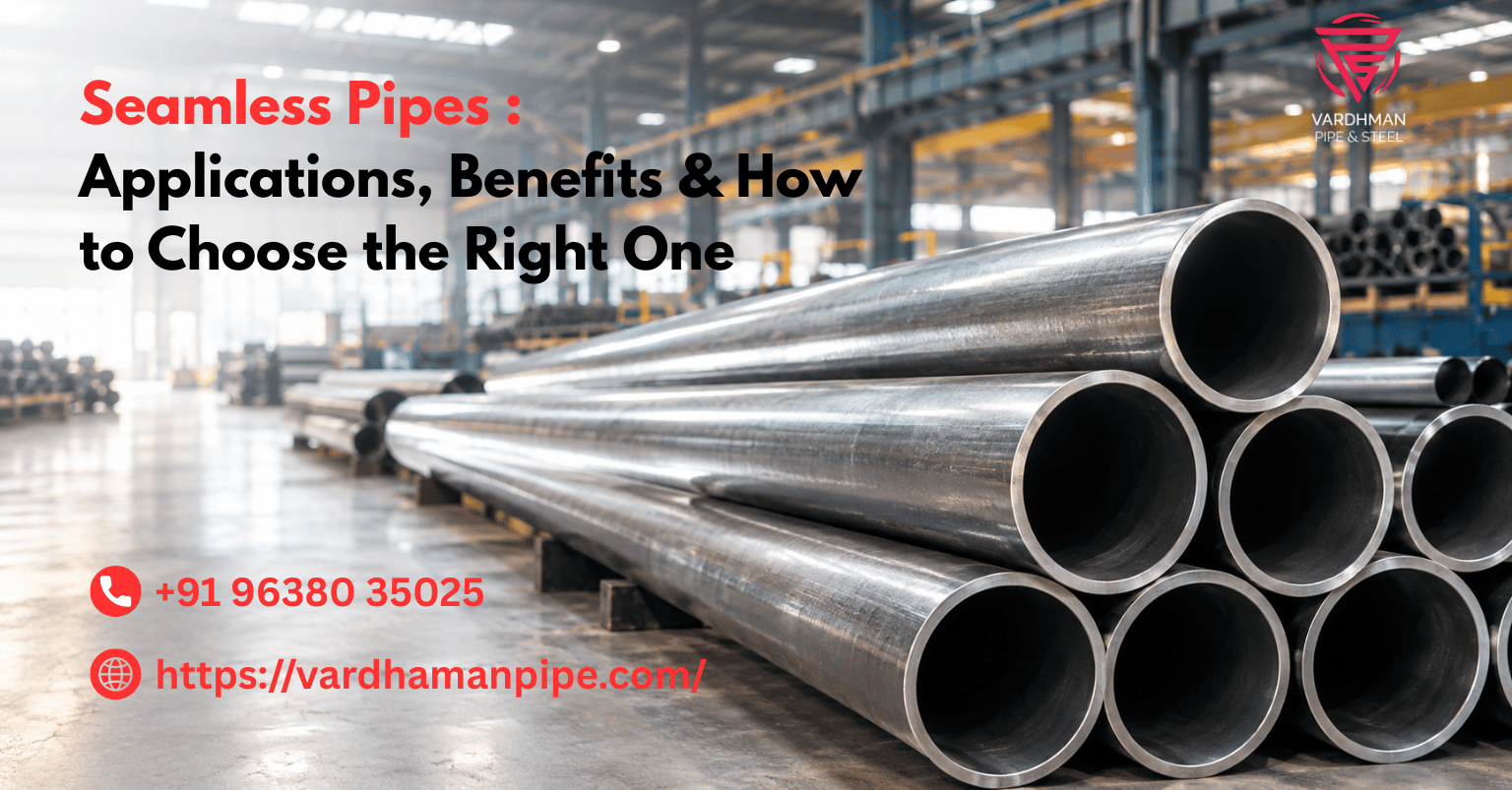
Choosing the right pipe for an industrial project is not only about selecting a size. Pressure, temperature, material, wall thickness, application conditions and applicable standards all play an important role. Seamless pipes are considered for applications where consistent pipe construction and reliable performance under demanding service conditions are important.
Unlike welded pipes, seamless pipes are manufactured without a longitudinal weld seam. This makes them suitable for several industrial applications where pressure, temperature and service conditions need to be carefully considered.
For buyers, however, the key question is not simply whether seamless pipes are better than welded pipes. The right question is: Are seamless pipes suitable for your specific application, and what size, thickness, material and specification should you select?
What Are Seamless Pipes?
Seamless pipes are steel pipes manufactured without a welded joint along the pipe body. A solid steel billet is heated and pierced to create a hollow tube, which is then processed to achieve the required dimensions and properties.
Because there is no longitudinal weld seam, seamless pipes provide a continuous pipe structure. This can be an important consideration in applications involving demanding pressure and temperature conditions.
However, pipe performance depends on more than the manufacturing method. Material grade, dimensions, wall thickness, manufacturing quality and applicable standards must also match the project requirements.
What Makes Seamless Pipes Different?
The main difference between seamless and welded pipes is their manufacturing construction.
A welded pipe is produced by forming steel into a cylindrical shape and joining the edges through a welding process. A seamless pipe starts from a solid billet that is pierced to form the hollow section.
This difference can make seamless pipes suitable for applications where the absence of a longitudinal weld is an important design consideration.
Key characteristics of seamless pipes include:
- Continuous construction without a longitudinal weld seam
- Suitability for demanding pressure applications, depending on specification
- Availability in different materials, sizes and wall thicknesses
- Applications across multiple industrial sectors
- Selection based on pressure, temperature, fluid, size and applicable standards
Seamless Pipe Applications Across Industries
Seamless pipes are used in industries where pipe performance must match demanding operating conditions. The appropriate pipe specification depends on the application rather than simply the industry name.
Oil & Gas
Seamless steel pipes can be used in oil and gas applications where pressure, temperature and service conditions require suitable pipe specifications.
Power Generation
Power plants may use seamless pipes in systems involving high-temperature or high-pressure service. The required material, thickness and standard depend on the specific piping system.
Petrochemical Industries
Petrochemical facilities handle different fluids, temperatures and pressures. Seamless pipes may be selected for suitable process piping applications based on material compatibility and operating conditions.
Industrial & Engineering Applications
Seamless pipes are also used in various industrial machinery, engineering and process applications where the required specifications call for seamless construction.
Construction & Structural Applications
Certain construction and engineering applications may require seamless pipes depending on the design, loading conditions and applicable specifications. The correct pipe should always be selected according to the project’s engineering requirements.
Example: Seamless Pipes in Power Generation
Power generation systems can involve elevated temperatures and pressures, particularly around steam and process systems.
In such applications, pipe selection needs to consider:
- Operating pressure
- Operating temperature
- Material grade
- Wall thickness
- Pipe dimensions
- Applicable standards
- Long-term service conditions
This is why simply selecting a pipe based on diameter is not sufficient for demanding industrial applications. The complete specification needs to match the system requirements.
Benefits of Seamless Pipe
The benefits of seamless pipes depend on their specification and application, but several characteristics make them suitable for demanding industrial requirements.
1. Continuous Pipe Construction
The absence of a longitudinal weld seam can be an important consideration for applications where continuous pipe construction is required.
2. Suitable for Demanding Pressure Conditions
Seamless pipes can be selected for high-pressure applications when the material, wall thickness and applicable standard are suitable for the operating conditions.
3. Consistent Pipe Structure
The manufacturing process produces a continuous pipe body, which can be advantageous for certain engineering applications.
4. Wide Industrial Application
Seamless pipes are used across sectors such as power generation, oil and gas, petrochemical processing and general engineering.
5. Selection Flexibility
Different materials, sizes, wall thicknesses and specifications allow seamless pipes to be selected according to specific project requirements.
Important: Seamless construction itself does not automatically mean that a pipe has better corrosion resistance or is suitable for every high-pressure application. Material grade, coating, environment, pressure rating and applicable standards must also be considered.
How to Choose the Right Seamless Pipe
For procurement teams and project engineers, choosing the right seamless pipe starts with understanding the actual application.
1. Determine the Application
First identify where the pipe will be used.
For example:
- Process piping
- Power generation
- Industrial machinery
- Oil & gas applications
- Petrochemical systems
- General engineering
Different applications can require different pipe specifications.
2. Select the Correct Pipe Size
Pipe diameter should match the requirements of the piping system, including flow requirements and connection arrangements.
Do not select a pipe based only on the available size. Confirm the required NB/OD, ID and dimensional specification for the project.
3. Check Wall Thickness
Wall thickness is an important consideration for pressure, mechanical strength and service conditions.
The required thickness should be determined according to the application’s engineering requirements rather than simply choosing the thickest available pipe.
4. Consider Material and Grade
Material selection should match the operating environment.
Depending on the application, requirements may involve:
- Carbon steel
- Alloy steel
- Stainless steel
- Other specified grades
Material compatibility with the conveyed fluid and operating temperature should be checked before ordering.
5. Check Pressure and Temperature
For demanding applications, confirm:
- Working pressure
- Design pressure
- Operating temperature
- Design temperature
These parameters help determine the appropriate pipe specification.
6. Verify Applicable Standards
Before purchasing, confirm the required standard, grade and certification requirements for your project.
This is particularly important for industrial procurement where documentation and traceability may be required.
Common Mistakes to Avoid When Buying Seamless Pipes
Choosing only by diameter
A 4-inch or 6-inch pipe, for example, does not provide enough information to determine whether it is suitable for an application. Wall thickness, material grade and standard also matter.
Ignoring the operating conditions
Pressure, temperature and the type of fluid being transported should be considered before finalizing the pipe.
Assuming every seamless pipe is suitable for high pressure
Seamless construction does not automatically make every pipe suitable for every high-pressure application. The complete specification must match the design requirements.
Ignoring material compatibility
The pipe material should be compatible with the fluid and surrounding environment to reduce the risk of premature degradation.
Not checking documentation
For industrial projects, buyers should confirm the required specifications, standards, test certificates and other documentation before placing a bulk order.
Seamless Pipe vs Welded Pipe: What Should You Consider?
The choice between seamless and welded pipe should be based on the actual application rather than assuming one type is universally better.
| Factor | Seamless Pipe | Welded Pipe |
|---|---|---|
| Manufacturing | Made from solid billet | Formed and welded |
| Longitudinal weld | No | Yes |
| Typical consideration | Demanding service conditions | Wide range of general and industrial applications |
| Selection factors | Grade, size, thickness, pressure, temperature | Grade, size, thickness, weld quality, pressure, temperature |
| Cost | Can be higher depending on specification | Can be more economical for many applications |
The right choice depends on application requirements, specification, availability, project standards and overall cost considerations.
MS Seamless Pipes for Industrial Requirements
For buyers looking for MS seamless pipes, Vardhman Pipe & Steel offers MS Seamless Pipes as part of its industrial steel product range.
When discussing a seamless pipe requirement, buyers should provide details such as:
- Required pipe size
- Wall thickness
- Quantity
- Application
- Required material/grade
- Project location
- Applicable standard, if specified
Providing these details helps the supplier understand the requirement and provide a more relevant quotation.
Seamless Pipe Supplier in Ahmedabad
If you are looking for a seamless pipe supplier in Ahmedabad, Vardhman Pipe & Steel can assist with MS seamless pipe requirements for industrial and engineering applications.
Instead of selecting a pipe only by price or size, discuss your actual application and specification with the supplier before placing a bulk order.
Vardhman Pipe & Steel serves industrial buyers looking for steel pipes and related products, including MS Seamless Pipes, ERW pipes, GI pipes, large-diameter MS & GI pipes and pipe fittings.
Frequently Asked Questions
What are seamless pipes used for?
- Seamless pipes are used in various industrial applications, including power generation, oil and gas, petrochemical, engineering and process-related applications where the required specification calls for seamless construction.
Are seamless pipes suitable for high-pressure applications?
- They can be suitable for high-pressure applications when the pipe’s material, wall thickness, grade and applicable standard are appropriate for the specified operating conditions.
Are seamless pipe better than welded pipes?
- Neither type is universally better. The appropriate choice depends on the application’s pressure, temperature, material, dimensions, standards, availability and project requirements.
Are seamless pipes more expensive than welded pipes?
- Seamless pipes can have a higher purchase cost depending on their size, material and specification. The overall choice should consider technical requirements as well as project economics.
How do I choose the right seamless pipe?
- Consider the application, pipe size, wall thickness, material grade, pressure, temperature, fluid compatibility and applicable standards before purchasing.
Where can I buy seamless pipes in Ahmedabad?
- Vardhman Pipe & Steel supplies MS Seamless Pipes for industrial requirements in Ahmedabad and can assist buyers based on their required size, specification and quantity.
Looking for the Right Seamless Pipe for Your Project?
Choosing the right seamless pipe depends on your application, required size, wall thickness, material specification and operating conditions. If you are looking for MS seamless pipes in Ahmedabad for an industrial requirement, Vardhman Pipe & Steel can help you identify a suitable product based on your project requirements.
Share your required pipe size, thickness, quantity and application with our team to discuss your requirement and request a quotation.
Explore our MS Seamless Pipe or contact Vardhman Pipe & Steel for your industrial pipe requirements.
